
Welcome to WordPress. This is your first post. Edit or delete it, then start writing!
Best Commerce Coaching in USA for International Students

Commerce Coaching USA for International Students: Complete 2026 Career Roadmap
The ₹1–2 Crore Decision That Can Define Your Future
If you are searching for commerce coaching USA, you are not just looking for classes.
You are trying to make a high-stakes decision that can shape your career, financial future, and global opportunities. Many students rush into studying abroad without a clear plan. They follow trends, advice from friends, or random online suggestions. As a result, they face confusion, delays, and unnecessary expenses.
You must approach this decision with clarity and strategy.
Commerce Coaching USA for International Students: Why It Matters
You cannot treat commerce education in the USA the same way you treat it in India.
In India, commerce is a fixed stream. In the United States, universities offer flexible programs instead of a single “commerce” stream. Students choose majors such as:
- Accounting
- Finance
- Business Administration
- Economics
This flexibility creates opportunity—but also confusion.
When you choose the right commerce coaching USA, you gain clarity about your direction. You stop guessing and start planning.
What Commerce Coaching in USA Helps You Achieve
- You understand the education system clearly
- You select the correct major
- You align studies with your career goals
- You reduce financial risks
- You avoid common mistakes
Without proper guidance, even smart students make poor decisions.
Understanding the US Education System Before Choosing Commerce Coaching USA
You must understand the system before selecting any coaching or course.
Credit System Explained in Commerce Coaching in USA
The US education system works on credits, not fixed subjects.
- Each subject carries credits
- You must complete a required number of credits
- You can choose subjects based on your goals
This system gives flexibility, but it also demands planning.
If you ignore credit planning:
- You may choose irrelevant subjects
- You may delay graduation
- You may increase your costs
Major and Minor Selection in Commerce Coaching in USA
US universities allow you to choose:
- Major → your main specialization
- Minor → an additional subject
Example:
- Major: Accounting
- Minor: Data Analytics
This combination can improve your career opportunities—but only if you plan it correctly.
Why Students Struggle Without Commerce Coaching in USA
Students struggle because they:
- Do not understand the system
- Copy others without thinking
- Ignore long-term career impact
You must avoid these mistakes.
Commerce Coaching USA: Key Academic Challenges Students Face
Let’s look at the real challenges students face.
Credit Transfer Problems in Commerce Coaching in USA
Many students assume their previous education will fully transfer.
In reality:
- Universities reject some credits
- Students repeat subjects
- Costs increase
CPA 150 Credit Requirement in Commerce Coaching in USA
If you want to become a CPA:
- You must complete 150 credits
- Most degrees offer only 120 credits
You must plan this gap early.
If you do not plan:
- You take random extra courses
- You waste time and money
Lack of Career Clarity
Many students start without a clear goal.
They:
- Change majors
- Feel confused
- Lose direction
You must decide your path early.
How to Choose the Right Commerce Coaching USA
You must choose coaching based on strategy—not popularity.
1. Career-Focused Approach
Your coaching must help you answer:
- What career do I want?
- What degree supports it?
- What skills do I need?
2. Academic Planning Support
Good coaching helps you:
- Select the right subjects
- Plan your credits
- Align with certifications like CPA
3. Skill Development
In the USA, skills matter more than marks.
You must build:
- English communication
- Confidence
- Presentation skills
4. Long-Term Strategy
You need a plan for:
- 3–5 years
- Degree + career path
- Backup options
Commerce Coaching USA for International Students: Features to Look For
You must evaluate coaching carefully.
Structured Roadmap
Choose coaching that provides:
- Clear step-by-step planning
- Defined career direction
Personalized Guidance
Avoid generic teaching.
You need:
- Individual attention
- Customized planning
Global Preparation
You must prepare for:
- Cultural differences
- Competitive environment
- Academic expectations
Practical Learning
Focus on:
- Real-world concepts
- Case studies
- Application-based learning
Career Options After Commerce Coaching USA Preparation
Your career choice defines your future.
CPA (Certified Public Accountant)
- High demand in the USA
- Stable career
- Strong growth
Best for students interested in accounting and taxation.
CFA (Chartered Financial Analyst)
- High earning potential
- Global recognition
- Challenging exams
Best for students interested in finance and investments.
MBA and STEM Programs
You must understand this difference:
- Traditional MBA → limited work opportunities
- STEM MBA → better job prospects
This decision affects your future visa options.
Finance + Data Careers
Modern careers combine:
- Finance
- Data analytics
Skills required:
- Excel
- SQL
- Data tools
Why Commerce Coaching USA Guidance Is Important for Students
Many students fail because they lack direction—not ability.
Common Mistakes
Students often:
- Choose degrees randomly
- Ignore credit requirements
- Delay career decisions
- Follow others blindly
Real Consequences
These mistakes lead to:
- 1–2 years wasted
- ₹10–20 lakh extra expenses
- Career confusion
You must avoid this.
Step-by-Step Roadmap After Choosing Commerce Coaching USA
Follow this structured roadmap.
Step 1: Define Your Career Goal
Choose your path:
- CPA
- CFA
- MBA
Step 2: Select the Right Degree
Ensure your degree supports your goal.
Step 3: Plan Credits Early
Plan:
- Total credits
- Additional requirements
- Certification alignment
Step 4: Build Skills
Work on:
- Communication
- Networking
- Internships
Step 5: Follow Strategic Guidance
Choose coaching that focuses on outcomes.
Commerce Coaching USA: Strategic vs Basic Coaching
| Factor | Basic Coaching | Strategic Coaching |
|---|---|---|
| Focus | Subjects | Career |
| Planning | Limited | Structured |
| Approach | Generic | Personalized |
| Goal | Exams | Long-term success |
You must choose strategy over convenience.
Why Concept Classes of Commerce Is a Strong Choice
Academic Leadership
- Nirupam Naudiyal
- CMA Gold Medalist
- 20+ years experience
Proven Results
- 10,000+ students trained
- Strong conceptual clarity
International Preparation
Students learn:
- Global education systems
- Career alignment
English-Based Learning
Students improve:
- Communication
- Confidence
- Interview skills
Frequently Asked Questions
Can I study commerce in the USA after 12th?
Yes. You can choose business-related majors such as finance or accounting.
What is the 150 credit requirement?
It is required for CPA eligibility. You must plan it early.
Which is better: CPA or CFA?
- CPA → stable career
- CFA → higher growth but more difficulty
Do I need coaching?
It is not mandatory, but it helps you avoid mistakes and build clarity.
What is the biggest mistake students make?
They start without a plan.
Final Thoughts: Make a Smart Decision
Studying in the USA is a major investment.
You must:
- Plan your academics
- Define your career
- Make informed decisions
Searching for commerce coaching USA is your first step.
Now you must take the next step with clarity.
Start With Clarity Today
Before you invest your time and money:
- Understand your path
- Plan your strategy
- Avoid costly mistakes
Because once you make this decision…
👉 you cannot undo it.
CA vs CMA After 12th: Which Course Is Better in India?
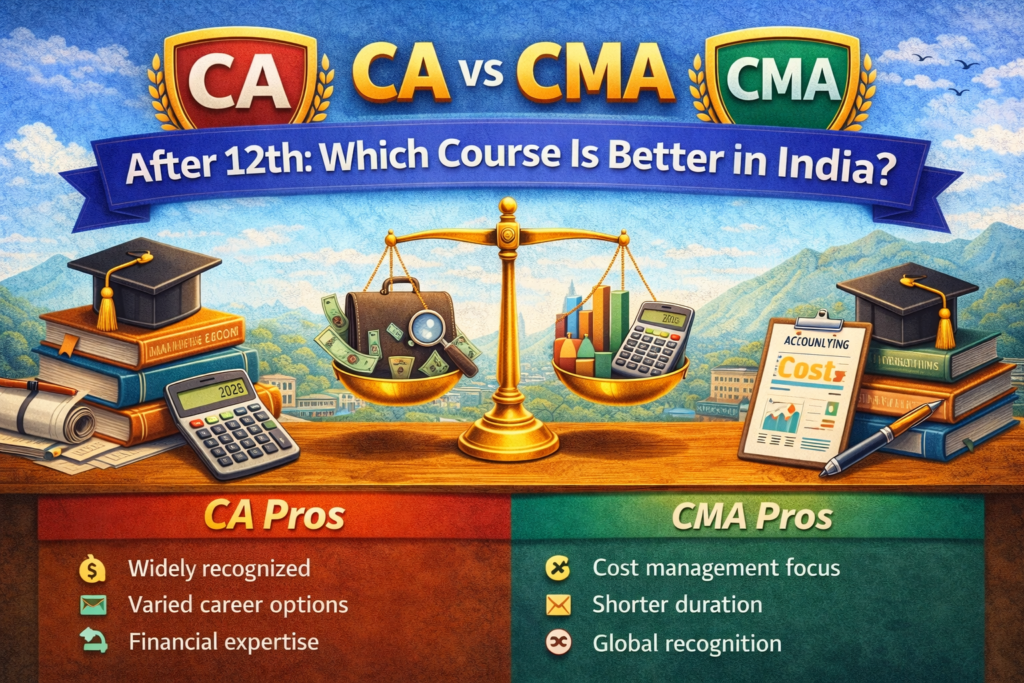
CA vs CMA After 12th: Which Course Is Better in India?
Choosing a professional career after Class 12 can feel overwhelming for commerce students. When students research CA vs CMA after 12th, they are usually trying to understand which qualification offers better career opportunities, salary potential, and long-term stability in the finance industry.
Both Chartered Accountancy (CA) and Cost and Management Accountancy (CMA) are prestigious professional courses in India. However, they lead to different career paths, require different skill sets, and offer different work environments.
This guide explains the complete comparison of CA vs CMA after 12th, including course structure, difficulty level, salary prospects, career scope, and future opportunities.
By the end of this article, you will clearly understand which course is better for your career goals.
Understanding the Difference in CA vs CMA After 12th
Before deciding between the two, students must understand that CA and CMA serve different roles in the financial ecosystem.
Chartered Accountants focus mainly on financial compliance, taxation, auditing, and regulatory reporting. Their job is to ensure businesses follow financial laws and maintain transparency.
Cost and Management Accountants focus on internal business strategy, cost management, and financial decision-making. Their role is to improve business efficiency and profitability.
In simple terms:
- CA ensures financial accuracy and legal compliance
- CMA helps businesses optimize financial performance
Both professions are highly respected but require different career interests.
Why Students Compare CA vs CMA After 12th
When students search CA vs CMA after 12th, they are usually facing several concerns.
Many students want to know:
- Which course is easier to complete?
- Which course has better salary prospects?
- Which profession has higher respect in society?
- Which option offers faster career growth?
Parents also influence this decision. In many households, CA is still seen as the “gold standard” commerce qualification.
However, the growing corporate sector in India has increased demand for CMA professionals who specialize in financial strategy and cost management.
Understanding these differences helps students make a more informed career decision.
CA Course Structure After 12th
The Chartered Accountancy course is conducted by the Institute of Chartered Accountants of India (ICAI).
CA Levels
- CA Foundation
- CA Intermediate
- Articleship Training (2 years)
- CA Final
Average Course Duration
The CA course generally takes 4.5 to 5 years to complete.
However, some students take longer due to exam attempts.
Key Subjects in CA
The CA curriculum focuses heavily on accounting, auditing, and taxation.
Important subjects include:
- Financial Reporting
- Direct Tax
- GST and Indirect Tax
- Corporate Law
- Auditing and Ethics
- Strategic Financial Management
These subjects prepare students for roles in financial compliance and corporate governance.
CMA Course Structure After 12th in the CA vs CMA Comparison
The Cost and Management Accountancy course is conducted by the Institute of Cost Accountants of India (ICMAI).
CMA Levels
- CMA Foundation
- CMA Intermediate
- Practical Training (15 months)
- CMA Final
Average Course Duration
The CMA course typically takes 3 to 4 years to complete.
Key Subjects in CMA
The CMA syllabus focuses more on management accounting and financial strategy.
Important subjects include:
- Cost Accounting
- Strategic Cost Management
- Corporate Financial Reporting
- Performance Management
- Financial Planning and Analysis
- Risk Management
These subjects prepare students to work in corporate finance roles and strategic business positions.
CA vs CMA After 12th: Key Differences
1. Difficulty Level in CA vs CMA After 12th
The CA course is widely known for its very low pass percentages and high difficulty level.
Some CA Final exam sessions have pass rates below 15% for both groups combined.
CMA exams are still challenging but usually have slightly higher pass percentages, making the completion path somewhat more predictable.
Students who prefer high academic challenge and prestige often choose CA, while those seeking balanced difficulty and corporate roles may prefer CMA.
2. Training Experience
A major difference in the CA vs CMA after 12th comparison is the practical training requirement.
CA Articleship
CA students must complete two years of articleship training under a practicing CA firm.
Typical experiences include:
- Working on audits
- Filing tax returns
- Assisting with financial compliance
Stipends during articleship are usually between ₹3,000 and ₹15,000 per month depending on the firm and city.
CMA Practical Training
CMA students complete 15 months of practical training, often within corporate finance departments.
Typical roles include:
- Cost analyst
- Financial analyst
- Management trainee
Stipends during CMA training are often ₹10,000 to ₹25,000 per month.
This often provides better exposure to corporate business operations.
Salary Comparison in CA vs CMA After 12th
Salary depends on factors such as:
- skills
- exam attempts
- company reputation
- industry sector
Average Starting Salary
| Qualification | Average Starting Salary |
|---|---|
| CA | ₹6L – ₹12L per year |
| CMA | ₹4L – ₹9L per year |
High Salary Potential
Rank-holder Chartered Accountants can receive ₹20L+ packages from large consulting firms.
Experienced CMAs working in corporate leadership roles can earn ₹15L–₹20L+ packages within several years.
Many multinational companies value analytical finance skills, meaning salary differences often narrow as professionals gain experience.
Career Opportunities in CA vs CMA After 12th
Both professions offer strong career opportunities in India.
CA Career Paths
Chartered Accountants commonly work as:
- Statutory auditors
- Tax consultants
- Forensic accountants
- Financial controllers
- Compliance advisors
They often work in:
- Big 4 accounting firms
- consulting firms
- corporate finance departments
- independent audit practice
CMA Career Paths
Cost and Management Accountants commonly work as:
- Cost analysts
- Financial planning analysts
- Corporate finance managers
- Business strategy advisors
- Budget analysts
They are highly valued in sectors such as:
- manufacturing
- infrastructure
- logistics
- FMCG companies
- multinational corporations
Future Career Scope in CA vs CMA After 12th
The finance profession is evolving rapidly due to automation, artificial intelligence, and data analytics.
Routine accounting tasks are increasingly automated.
However, professionals who can interpret financial data and guide strategic decisions are becoming more valuable.
Future Roles for CAs
Chartered Accountants are moving toward roles such as:
- forensic auditing
- international taxation
- regulatory advisory
- sustainability reporting
Future Roles for CMAs
CMAs are increasingly involved in:
- financial planning and analysis (FP&A)
- cost optimization strategies
- business intelligence
- strategic finance leadership
Both careers remain highly relevant in the modern economy.
CA vs CMA After 12th: Which Course Should You Choose?
The right choice depends on your career interests and strengths.
Choose CA if you want to:
- specialize in auditing and taxation
- build an independent professional practice
- work in financial compliance roles
- pursue high-prestige professional recognition
Choose CMA if you want to:
- work in corporate finance
- focus on business strategy
- analyze company performance
- influence financial decision-making inside organizations
Understanding your long-term goals is essential when deciding CA vs CMA after 12th.
Why the Right Guidance Matters
Professional courses like CA and CMA require consistent preparation, conceptual clarity, and strategic study planning.
Many capable students struggle simply because they lack:
- proper mentorship
- structured preparation
- exam-focused practice
Guidance plays a crucial role in improving success rates in professional commerce education.
Why Concept Classes of Commerce (C3) Stands Out
At Concept Classes of Commerce (C3), we focus on building strong conceptual understanding rather than rote learning.
Our programs help students prepare for professional commerce careers with structured guidance and mentor support.
Key strengths include:
- 20+ years of teaching experience
- CMA-qualified faculty
- structured test series
- bilingual teaching approach
- personalized mentoring support
Our goal is to help students build confidence and clarity before entering professional courses like CA and CMA.
Frequently Asked Questions
Is CA better than CMA after 12th?
CA is better for students interested in auditing, taxation, and independent practice, while CMA is ideal for corporate finance and business strategy roles.
Which course is more difficult?
CA is generally considered more difficult due to lower pass percentages and rigorous exam evaluation.
Can CMA earn as much as CA?
Yes. Experienced CMAs in corporate leadership roles can earn salaries comparable to CAs, especially in manufacturing and multinational companies.
Can students pursue both CA and CMA?
Yes, some students attempt both courses simultaneously, but it requires strong time management and disciplined preparation.
Which course has better job security?
Both CA and CMA offer strong job security because finance professionals are essential in every industry.
CA Coaching in Haldwani: 2026 Strategic Guide
CA Coaching in Haldwani: 2026 Complete Strategic Guide for Serious Aspirants
If you are searching for CA coaching in Haldwani, you are likely looking for structured mentorship, clarity about the ICAI new scheme, and a practical roadmap to clear exams efficiently. In 2026, Chartered Accountancy preparation demands far more than classroom attendance. It requires disciplined execution, strong conceptual clarity, structured mock practice, and strategic articleship planning.
This detailed guide explains how CA coaching in Haldwani fits into the updated ICAI framework, what challenges students face in a Tier-2 city ecosystem, and how to prepare effectively from Foundation to Final without unnecessary attempts.
Why CA Coaching in Haldwani Is Becoming a Strategic Choice
Over the last decade, Haldwani has evolved into a serious commerce education hub for the Kumaon region. Students from Almora, Bageshwar, Pithoragarh, and nearby districts now prefer preparing locally instead of relocating to metro cities.
There are clear advantages.
First, the cost of living is significantly lower than Delhi or Jaipur. As a result, families can invest more in structured CA coaching in Haldwani rather than spending heavily on accommodation. Moreover, students benefit from family support, which plays a crucial role during difficult exam phases.
In addition, proximity to the Rudrapur–Pantnagar industrial belt creates strong articleship exposure. Therefore, the city offers both affordability and practical opportunity.
However, not every commerce institute provides complete professional preparation. Choosing the right institute remains critical.
ICAI New Scheme and Its Impact on CA Coaching in Haldwani
The CA course is regulated by the Institute of Chartered Accountants of India. The reforms implemented between 2024 and 2026 have significantly reshaped preparation patterns.
Students must understand these structural changes before beginning serious study.
Reduced Papers but Increased Conceptual Depth
Intermediate and Final levels now include six papers instead of eight. Although the number of papers has decreased, integration between subjects has increased complexity.
Therefore, memorization-based preparation is no longer effective. Students preparing through CA coaching in Haldwani must focus on understanding linkages between taxation, audit, costing, and financial management.
Concept clarity now directly impacts scoring consistency.
30% Objective Component and Mock Strategy
The introduction of a 30% MCQ component has transformed exam strategy. Importantly, there is no negative marking in this section.
Consequently, time-bound objective practice becomes essential. Any effective CA coaching in Haldwani must integrate structured MCQ testing within its academic system.
Students who regularly analyze mock performance improve significantly faster than those who rely only on theory completion.
Articleship Reduced to Two Years
The articleship period has been reduced to two years. While this shortens the overall journey to approximately 3.5–4 years, exposure quality is now more important than duration.
Students should evaluate firms based on:
- Nature of audit assignments
- Corporate client exposure
- Learning environment
- Industrial training scope
Early planning during Intermediate improves long-term career outcomes.
Real Challenges Faced by Students Preparing for CA in Haldwani
Although infrastructure has improved, aspirants still face structural and psychological challenges.
Lack of Structured Monitoring in Some CA Coaching in Haldwani
Many institutes complete syllabus on time. However, they do not provide continuous performance tracking.
Without:
- Weak area analysis
- Revision cycles
- Attempt readiness assessment
students often repeat groups unnecessarily.
Therefore, structured CA coaching in Haldwani must include evaluation-based preparation rather than lecture-only delivery.
Articleship Confusion Among CA Aspirants
Some students join the first available firm without evaluating exposure quality. While compliance work builds basics, it may limit long-term growth.
Instead, aspirants should strategically target firms offering audit diversity and industrial exposure.
Psychological Pressure in Tier-2 Cities
Professional degrees carry high expectations in smaller cities. Consequently, repeated attempts can damage confidence and motivation.
Institutes that combine mentorship with academic discipline help students maintain emotional stability throughout the journey.
Industrial Advantage Supporting CA Coaching in Haldwani
One of the strongest advantages of studying locally is proximity to the Rudrapur–Pantnagar industrial zone.
This region offers exposure in:
- Internal audits
- Cost control systems
- Financial reporting
- Corporate taxation
Students enrolled in CA coaching in Haldwani can combine academic preparation with practical exposure, which strengthens long-term employability.
How to Choose the Best CA Coaching in Haldwani
Selecting the right institute should be a strategic decision.
Faculty Expertise and Stability
Subject specialization ensures clarity in complex areas like Direct Tax and Financial Reporting. Therefore, verify faculty background before enrolling.
Mock Test Discipline in CA Coaching in Haldwani
Regular ICAI-pattern mock tests build exam confidence. Moreover, evaluation feedback identifies performance gaps early.
Institutes emphasizing structured testing consistently produce better results.
Mentorship and Attempt Strategy
Students need more than lectures. They require:
- Study planning
- Attempt timing advice
- Group strategy guidance
- Motivation during low phases
Effective CA coaching in Haldwani integrates these elements within its system.
Transparent Fee Structure
Clear communication builds parental trust and financial clarity. Avoid institutes that lack transparency.
Step-by-Step Roadmap for Success
A structured preparation framework prevents confusion.
Foundation Level
Focus on building strong accounting fundamentals and daily MCQ practice. Weekly revisions improve retention and reduce last-minute stress.
Intermediate Level
Prioritize integration across subjects. Identify weak topics early and strengthen them through repeated mock testing.
Articleship Phase
Treat articleship as a learning laboratory. Develop practical skills in GST, audit documentation, and compliance systems.
Final Level
Practice integrated case studies and follow disciplined revision cycles. Time management becomes critical at this stage.
Consistency and structured mentorship determine long-term success.
Technology and the Future of the CA Profession
Automation now handles routine bookkeeping. However, analytical and advisory roles continue to grow.
Therefore, students should develop complementary skills such as:
- Advanced Excel
- Financial analysis
- ERP familiarity
- Data interpretation
The future Chartered Accountant will combine regulatory knowledge with strategic insight.
Why Structured CA Coaching in Haldwani Makes a Long-Term Difference
Preparation without direction often leads to repeated attempts. In contrast, mentorship-driven systems create clarity and discipline.
Concept Classes of Commerce (C3) emphasizes:
- Concept-first teaching methodology
- ICAI-aligned test series
- Continuous performance monitoring
- Attempt planning guidance
- Parent communication support
With over 20 years of commerce education experience and mentorship of more than 1000 students, C3 focuses on building professionals rather than producing short-term results.
The objective is not just clearing exams.
The objective is building confident Chartered Accountants.
Frequently Asked Questions
Is CA coaching in Haldwani sufficient to clear exams?
Yes, provided structured mentorship, disciplined mock testing, and consistent effort are maintained.
Should students relocate to metro cities?
Not necessarily. Faculty quality and preparation strategy matter more than geography.
How long does qualification take under the new scheme?
Approximately 3.5 to 4 years including articleship.
Is industrial exposure important?
Yes. It significantly enhances employability and practical understanding.
Is CA still relevant in the AI era?
Absolutely. The profession is evolving toward advisory and strategic roles.
Final Thoughts
Choosing CA coaching in Haldwani should be a well-evaluated decision based on structure, mentorship, and long-term career planning. With disciplined execution and correct guidance, students from the Kumaon region can compete nationally.
Success in Chartered Accountancy is built on clarity, consistency, and strategic preparation.
Why Students Fail in Accountancy in 11th
Main Reasons for Low Marks in Class 11 Accountancy
Why students fail in Accountancy in 11th is one of the most searched academic questions among Commerce students in India. Every year, thousands of students who scored 85–95% in Class 10 suddenly struggle to pass Class 11 Accounts.
If your journal entries don’t make sense, if your trial balance never tallies, or if you feel Accounts is “not for you,” this article will give you clarity.
This is not motivational talk.
This is a structured breakdown of:
- Why students fail in Accountancy in 11th
- The real reasons for low marks in Class 11 Accounts
- Why 11th Accounts feels so hard
- And how to fix it before finals
Why Students Fail in Accountancy in 11th After Class 10 Success
The biggest shock for students is this:
You performed well in Class 10.
You chose Commerce confidently.
But now you are barely passing in Accounts.
The reason is simple.
Class 10 rewards memory.
Class 11 Accountancy rewards logic.
In Class 10:
- Theory dominates
- Questions are predictable
- Last-month revision works
In Class 11:
- Numerical application dominates
- Concept clarity matters
- Daily practice is compulsory
This transition shock is the first major reason why students fail in Accountancy in 11th.
Top Reasons Why Students Fail in Accountancy in 11th
Let’s break down the real reasons for low marks in Class 11 Accounts.
1. Rote Learning Instead of Conceptual Clarity
Many students try to memorize:
- Rules of debit and credit
- Journal formats
- Ledger structures
But Accountancy is logical.
If you don’t understand:
Who is giving the benefit?
Who is receiving the benefit?
You will keep making errors.
Understanding beats memorization in 11th Accounts.
2. Weak Foundation in Journal Entries in 11th Accountancy
Journal entries are the grammar of Accountancy.
If journal logic is weak:
- Ledger posting becomes confusing
- Trial balance does not tally
- Rectification becomes difficult
- Final accounts collapse
A weak journal foundation is one of the strongest reasons why students fail in Accountancy in 11th.
3. Fear After First Low Marks
The first unit test becomes a turning point.
Many students score 12/40 or 15/40.
Instead of fixing mistakes, they:
- Lose confidence
- Avoid long sums
- Focus on easier subjects
- Develop backlog
Fear leads to avoidance.
Avoidance leads to failure.
Why Is 11th Accounts So Hard for Commerce Students?
Students frequently search: Why is 11th Accounts so hard?
It feels hard because:
- It is a completely new subject
- It introduces business entity thinking
- It is cumulative
- It requires written practice daily
You cannot “read” Accounts.
You must solve it.
That shift makes students uncomfortable.
Why Students Fail in Journal Entries in 11th Accountancy
Journal entries confuse students because they think personally, not from a business perspective.
Example:
Owner withdraws cash.
Is it expense?
Is it capital reduction?
Without understanding drawings and capital adjustment, entries go wrong.
Weak journal clarity = repeated mistakes.
This is a core reason why students fail in Accountancy in 11th.
Why Students Lose Marks in Bank Reconciliation Statement in Class 11 Accounts
BRS is another high-friction chapter.
Students lose marks because they:
- Randomly add and subtract
- Don’t understand timing differences
- Confuse cash book with pass book
The issue is not math.
It is perspective.
When you understand why differences arise, BRS becomes logical.
Why Depreciation Causes Low Marks in 11th Accountancy
Depreciation creates confusion because:
- Students mix SLM and WDV
- They ignore working notes
- They treat it as only formula
Depreciation is conceptual first.
It reflects asset value reduction.
Ignoring concept leads to calculation errors.
Why Rectification of Errors Is a Major Reason Why Students Fail in Accountancy in 11th
Rectification requires triple thinking:
- What mistake happened?
- What should have happened?
- How to correct it?
This chapter exposes weak fundamentals.
Many students mentally give up here.
That increases failure probability significantly.
Backlog and Poor Practice: Hidden Reasons Why Students Fail in Accountancy in 11th
Many students treat Class 11 casually.
They think:
“I will study properly in Class 12.”
But Accountancy is cumulative.
If July concepts are weak, January chapters collapse.
Backlog is one of the biggest silent reasons for low marks in Class 11 Accounts.
How NEP Pattern Increased Why Students Fail in Accountancy in 11th
Under the competency-based exam pattern:
- 50% questions are application-based
- 20% are MCQs
- 30% are traditional
Students preparing only textbook questions are underprepared.
Now boards test:
- Case-based adjustments
- Integrated numerical problems
- Conceptual reasoning
Old memorization strategies no longer work.
Psychological Reasons Why Students Fail in Accountancy in 11th
Failure is emotional before it is academic.
The usual pattern:
- Confidence
- Confusion
- First low marks
- Fear
- Avoidance
- Backlog
Students start believing:
“Accounts is not for me.”
But the truth is:
They were never trained in analytical thinking before Class 11.
How to Pass After Understanding Why Students Fail in Accountancy in 11th
Now let’s fix it.
Step 1: Rebuild Journal Logic
Start from basics.
Master debit and credit.
If needed, read:
- The 5-Step Logic to Master Journal Entries
- Common Mistakes in Class 11 Accountancy
Step 2: Practice Daily (Minimum 45 Minutes)
Five questions daily are better than 50 before exams.
Consistency builds clarity.
Step 3: Maintain an Error Register
After every practice session, write:
- Type of mistake
- Correct logic
- Reason for confusion
Review weekly.
Patterns will emerge.
Step 4: Focus on Working Notes
Many students lose 20–30% marks because they:
- Skip proper format
- Don’t show calculations
- Ignore structured presentation
Even partial logic gives partial marks.
Step 5: Solve Full-Length Papers
Accountancy tests:
- Speed
- Accuracy
- Presentation
- Stamina
Practice 3-hour papers before finals.
Frequently Asked Questions
1. Why students fail in Accountancy in 11th even after studying?
Because they rely on memorization instead of daily logical practice.
2. Why is 11th Accounts so hard compared to 10th?
It requires analytical thinking and structured numerical solving.
3. Can I recover before finals if I failed mid-term?
Yes. Rebuild fundamentals and practice consistently.
4. Which chapters cause most failures?
Journal Entries, BRS, Depreciation, Rectification.
5. Is NCERT enough for Class 11 Accounts?
For concepts, yes. But practice is essential.
Final Summary: Why Students Fail in Accountancy in 11th and How to Fix It
The real reasons include:
- Rote learning
- Weak journal foundation
- Backlog
- Fear after low marks
- Ignoring competency-based preparation
Failure in Class 11 is not permanent.
It is feedback.
Change your method.
Focus on logic.
Practice daily.
Accountancy is not about memory.
It is about structured financial thinking.
And that skill can absolutely be learned.
DU BCom Maths requirement 2026: Complete Guide
DU BCom Maths requirement 2026: Official Eligibility Criteria
The DU BCom Maths requirement is one of the most important admission criteria for commerce students preparing for CUET 2026. Every year, thousands of students across India worry whether not having Mathematics in Class 12 will block their entry into Delhi University’s BCom (Hons) or BCom Program. The confusion is understandable — eligibility rules, CUET subject mapping, and internal course structure often get mixed up.
This guide explains the DU BCom Maths requirement for 2026 in complete detail — official eligibility, subject combinations, Applied Maths acceptance, Semester 3 mathematics papers, and the real career impact for students without Maths.
DU BCom Maths requirement 2026: Official Eligibility Criteria
Under the CUET framework followed by the University of Delhi, students can apply for BCom (Hons) through two valid combinations.
Mathematics / Applied Mathematics Route for DU BCom
You must appear in CUET with:
- 1 Language
- Mathematics or Applied Mathematics
- 2 Domain subjects
This route is generally preferred by students aiming for finance, analytics, or quantitative careers.
Accountancy Route Under DU BCom Maths Requirement
You must appear in CUET with:
- 1 Language
- Accountancy or Bookkeeping
- 2 Domain subjects
This confirms that Maths is not compulsory for admission if you studied Accountancy in Class 12.
However, this only solves the entry requirement — not the academic structure inside BCom (Hons).
Understanding the DU BCom Maths requirement for Admission
Many students confuse admission eligibility with academic curriculum.
Let’s clarify:
- ❌ Maths is not compulsory for entry if you qualify through Accountancy.
- ✅ Quantitative subjects are compulsory within BCom (Hons).
So while you may bypass Mathematics during admission, you cannot bypass Business Mathematics and Statistics inside the degree.
This distinction is critical.
Maths Requirement for DU BCom Hons Explained
The maths requirement for DU BCom Hons becomes visible during second year.
Core quantitative papers usually include:
- Business Mathematics
- Business Statistics
- Mathematics of Finance
These subjects are not optional.
Even students admitted through Accountancy must clear them to graduate.
DU BCom Admission Without Maths: Subject Combination Rules
One of the biggest reasons students lose admission is incorrect CUET subject mapping.
Rule:
You must take CUET in subjects you studied in Class 12.
Common mistake:
A student without Maths in Class 12 attempts to take Mathematics in CUET to improve eligibility.
Result:
Application rejection during verification.
Always ensure CUET subjects align exactly with your Class 12 marksheet.
Business Mathematics Requirement in DU BCom Hons
This is where most non-maths students experience difficulty.
Business Mathematics in DU BCom Hons
Topics include:
- Matrices
- Determinants
- Linear programming
Statistics and Quantitative Papers in DU BCom
Students also study:
- Measures of central tendency
- Probability
- Hypothesis testing
Mathematics of Finance Concepts
Includes:
- Compound interest
- Annuities
- Sinking funds
Example formula:PV=R⋅i1−(1+i)−n
If you stopped studying Maths after Class 10, this transition can feel steep.
This is why many students struggle in Semester 3.
Impact of Not Meeting DU BCom Maths Requirement Academically
Even if you qualify for admission, weak quantitative preparation can lead to:
- Backlogs in Business Mathematics
- Lower overall CGPA
- Reduced confidence in finance-related internships
The issue is not eligibility.
It is preparedness.
Students who build basic algebra and financial mathematics early perform significantly better.
DU BCom Without Maths: Admission in Top Colleges
Colleges such as:
- Shri Ram College of Commerce
- Hindu College
follow central eligibility rules.
If you qualify through the Accountancy combination and secure a high CUET score, you are eligible.
However, many top-performing students tend to have stronger analytical backgrounds, which helps in academic performance later.
Eligibility ensures entry. Preparation ensures success.
Career Scope After DU BCom Without Maths
Does not having Maths limit your career?
Only if you choose highly quantitative sectors without preparation.
High-Quantitative Careers After DU BCom
- Investment Banking
- Actuarial Science
- Quantitative Finance
- Data Analytics
These require strong mathematical foundations.
Non-Maths Career Options in Commerce
- Company Secretary
- Corporate Law
- Compliance & Governance
- Management roles
For example, the Institute of Company Secretaries of India provides a professional pathway that does not require advanced calculus.
Many CS professionals build stable and high-paying careers.
So the absence of Maths does not eliminate opportunity — it changes strategic direction.
Preparation Strategy for DU BCom Maths Papers
If you are entering through the Accountancy route, structured preparation is essential.
Strengthen Basics
Revise:
- Algebra fundamentals
- Ratios and percentages
- Linear equations
Prepare for Business Mathematics in DU BCom
Learn:
- Basic derivative concepts
- Financial mathematics
- Introductory statistics
Build Analytical Skills Beyond the Maths Requirement
Focus on:
- Excel proficiency
- Financial modeling basics
- Logical reasoning
- Data interpretation
In today’s AI-driven job market, analytical thinking matters more than rote calculation.
FAQs on DU BCom Maths requirement
1. Is Maths compulsory for BCom Hons in DU 2026?
No, not for admission if you studied Accountancy. But mathematics papers are compulsory within BCom (Hons).
2. Is Applied Mathematics accepted?
Yes, Applied Mathematics is fully valid under the eligibility framework.
3. Can I take Maths in CUET if I did not study it in Class 12?
No. CUET subjects must match your Class 12 subjects.
4. Is BCom Program safer for non-maths students?
It involves relatively lower quantitative intensity compared to Hons.
5. Does not having Maths reduce placement chances?
Only in high-quantitative sectors if you do not build analytical skills separately.
Final Strategic Insight
The DU BCom Maths requirement should not create panic.
It should create planning.
You have three structured options:
- Enter through the Mathematics route and maintain quantitative strength.
- Enter through the Accountancy route and build foundational skills early.
- Choose BCom Program aligned with long-term career goals.
The real disadvantage is not lacking Maths.
The real disadvantage is ignoring preparation.
Admission-Focused Closing Note
Delhi University admissions are competitive and policy-driven.
One incorrect subject choice.
One CUET mapping error.
One unprepared semester.
That is enough to create regret.
Plan early.
Build clarity.
Strengthen analytical confidence.
Admission success is not luck.
It is structured strategy.
Commerce with Maths Haldwani: What to Choose?

Commerce with Maths Haldwani: The Ultimate Stream Decision Guide After Class 10
Choosing your stream after Class 10 is stressful — especially when you are stuck between Commerce with Maths Haldwani and dropping Maths completely. For students in Haldwani, this decision is not just about subjects. It affects DU eligibility, MBPG merit lists, CA preparation, career salary, and long-term opportunities.
Many students take Maths out of fear.
Many drop Maths out of anxiety.
Very few take a strategic decision.
This guide will give you complete clarity — academically, professionally, and locally — so you can choose the right path with confidence.
Commerce with Maths Haldwani: Why This Decision Feels So Confusing
Students in Haldwani face three major pressures:
1. Social Hierarchy Pressure
There is an invisible ranking system:
Science > Commerce with Maths > Commerce without Maths
Because of this, dropping Maths often feels like a “step down.”
But career reality does not follow social hierarchy.
2. Fear of Closing Doors
Students worry:
- “What if DU rejects me?”
- “What if I can’t do CA?”
- “What if MBA requires Maths?”
This fear pushes students into subjects they may not be suited for.
3. Percentage vs Prestige Dilemma
In Haldwani, colleges like Motiram Baburam Government Post Graduate College (MBPG) admit students based on merit percentage.
If Maths reduces your overall percentage, it directly hurts your admission chances.
So the real dilemma is:
Higher percentage without Maths
OR
Prestige of taking Maths?
Let’s break it down logically.
Commerce with Maths Haldwani vs Without Maths: What Actually Changes?
Here’s the practical difference.
If You Take Maths
You can apply for:
- B.A. (Hons) Economics
- BMS / BBA (FIA)
- Quant-based finance roles
- Data analytics (long-term advantage)
But:
- Syllabus pressure increases
- Tuition cost increases
- Risk of lower board percentage increases
If You Drop Maths
You can still apply for:
- B.Com (Hons)
- B.Com (Programme)
- CA / CS / CMA
- Law
- Digital Marketing
- Management
- MBA (after graduation)
But:
- You cannot apply for Economics (Hons)
- You cannot apply for certain DU management programs
So the difference is eligibility-based, not intelligence-based.
Commerce with Maths Haldwani and Delhi University Reality
Most confusion in Haldwani is related to Delhi University.
Let’s clarify the truth.
Is Maths Compulsory for B.Com (Hons)?
Earlier → Yes.
Now (CUET pattern) → No.
Students can apply through:
Language + Accountancy + 2 domain subjects.
Maths is optional for B.Com (Hons).
This is a major structural shift.
When Is Maths Still Compulsory?
Maths (Core or Applied) is mandatory for:
- B.A. (Hons) Economics
- BMS
- BBA (FIA)
If you drop Maths, these doors close.
Simple and clear.
Commerce with Maths Haldwani and MBPG Admission Strategy
If your backup plan is Haldwani:
Kumaun University
Motiram Baburam Government Post Graduate College
Here is the reality:
- Admission is merit-based.
- Higher aggregate percentage matters more than subject combination.
- Maths does not get separate weightage.
This means:
If Maths reduces your board percentage, it directly reduces your local admission rank.
For students staying in Haldwani, percentage strategy matters more than subject prestige.
Applied Maths vs Core Maths in Commerce with Maths Haldwani
This is where most students lack clarity.
CBSE offers two options:
Core Maths (041)
Includes:
- Trigonometry
- Vector Algebra
- 3D Geometry
- Heavy calculus
Designed originally for Science-oriented students.
Applied Maths (241)
Includes:
- Financial Mathematics
- EMI and Tax calculations
- Statistics
- Business mathematics
- Data interpretation
Removes advanced trigonometry and 3D geometry.
Delhi University accepts Applied Maths.
For commerce-focused students, Applied Maths is often the strategic middle path.
Career Scope After Commerce with Maths Haldwani
Let’s move beyond college admission.
Career matters more.
Careers That Require Maths
- Economics (Hons)
- Quant Finance
- Investment Banking
- Actuarial Science
- Advanced Data Analytics
These require strong mathematical base.
Careers Where Maths Is Helpful but Not Mandatory
- Chartered Accountant
- Company Secretary
- CMA
- MBA
- Financial Analyst
Even Institute of Chartered Accountants of India does not mandate Maths in Class 11–12.
CA Foundation includes quantitative aptitude — not advanced calculus.
Careers That Do Not Need Maths
- Digital Marketing
- Brand Management
- HR
- Law
- Entrepreneurship
- E-commerce
- Business Consulting
In fact, AI and automation are reducing demand for basic manual accounting.
Skill adaptability is becoming more important than subject choice.
Salary Comparison: Commerce with Maths Haldwani vs Without Maths
Subject choice does not directly decide salary.
Career path does.
Broadly:
- Quant finance roles (Maths-heavy) → Higher metro salaries
- CA → Strong long-term earning potential
- Digital marketing → Fast growth, remote work possible from Haldwani
- Local accounting → Stable but lower growth
But remember:
AI is automating routine bookkeeping.
Future-ready skills matter more than subject ego.
Financial Calculation: Is Taking Maths Worth the Tuition Cost?
In Haldwani, Maths tuition is common.
Parents often invest heavily in:
- Separate Maths coaching
- Extra practice material
- Test series
Ask this:
If you drop Maths and save that cost, can you invest in:
- CUET preparation
- CA Foundation coaching
- Digital skills
- Advanced Excel + AI tools
Sometimes dropping Maths gives you time + money advantage.
Final Decision Framework for Commerce with Maths Haldwani
Answer honestly:
- Do I genuinely enjoy solving numerical problems?
- Am I targeting Economics (Hons)?
- Does my school offer Applied Maths?
- Will Maths reduce my board percentage?
- What skill will I build if I drop Maths?
Take Maths If:
- You aim for Economics or quant roles
- You are comfortable with mathematics
- You want maximum academic flexibility
Choose Applied Maths If:
- You want DU flexibility
- You fear heavy trigonometry
- You want business-focused mathematics
Drop Maths If:
- You are clear about CA, law, management, or digital careers
- Maths lowers your confidence and percentage
- You want to focus deeply on Accountancy and Economics
Why Strategic Stream Selection Matters in Haldwani
Many tuition centers simply push:
“Join Maths batch.”
Very few ask:
“Do you actually need Maths?”
At Concept Classes of Commerce (C3), we guide students based on:
- Career clarity
- College eligibility
- Strength assessment
- Risk analysis
- Long-term positioning
We don’t sell subjects.
We build career strategy.
FAQs – Commerce with Maths Haldwani
Is Maths compulsory for DU B.Com (Hons)?
No. Accountancy route is available.
Can I become CA without Maths?
Yes. Maths is not mandatory for CA eligibility.
Does MBPG College require Maths?
No. Admission depends on overall percentage.
Is Applied Maths easier than Core Maths?
Generally yes, because it removes heavy trigonometry and 3D geometry.
Will dropping Maths reduce my future salary?
No. Career path and skill development matter more.
Final Advice for Students in Haldwani
The debate of Commerce with Maths Haldwani is not about intelligence.
It is about alignment.
Taking Maths out of fear is a mistake.
Dropping Maths without strategy is also a mistake.
Make the decision based on:
- Target college
- Target career
- Academic strength
- Mental health
- Skill-building plan
Confused About Your Stream?
Don’t risk two important years on guesswork.
At Concept Classes of Commerce (C3):
✔ 20+ years commerce mentoring
✔ CMA-qualified academic leadership
✔ 1000+ students mentored
✔ Bilingual teaching (Hindi + English)
✔ CUET + CA focused guidance
Visit our center in Haldwani.
Talk to a mentor.
Choose once — choose correctly.
Commerce After 10th in Haldwani – Complete 2026 Guide
Why Choose Commerce After 10th in Haldwani
Choosing Commerce after 10th in Haldwani is no longer a backup option — it is becoming a strategic career decision for students who want stability, professional growth, and long-term financial independence.
With Haldwani acting as the gateway to the Kumaon region and connecting closely to industrial hubs like Rudrapur and Pantnagar, commerce education now directly aligns with real economic opportunities.
In this complete guide, students and parents will understand:
- Subjects in Class 11 Commerce
- Career paths like CA, B.Com, BBA and MBA
- Higher education options near Haldwani
- Salary expectations in the regional market
- AI impact on commerce careers
- A structured roadmap for 2026
If you are confused about whether to pursue this stream, At Concept Classes of Commerce (C3), we help students build structured clarity from Class 11 itself.
Why Choose Commerce After 10th in Haldwani?
Students who enjoy numbers, logical thinking, and business discussions often perform better in commerce than in science.
Commerce is ideal for students who:
- Prefer analytical reasoning over memorizing formulas
- Want careers in finance or management
- Aspire to become CA, MBA, or entrepreneurs
- Seek corporate or banking careers
The local ecosystem supports this pathway due to growing retail, industrial, and financial activities in the region.
Subjects in Commerce After 10th in Haldwani
When students opt for the commerce stream in Haldwani, they typically study:
- Accountancy
- Business Studies
- Economics
- English
- Mathematics (optional but highly recommended)
Is Commerce After 10th in Haldwani Difficult in Class 11?
Many students experience difficulty in Accountancy during the first few months.
This happens because:
- Double Entry System is entirely new
- Logical precision is required
- Regular practice becomes essential
Strong fundamentals in Class 11 make Class 12 much smoother.
Schools Offering Commerce Stream in Haldwani (Information Only)
Students can explore the following institutions offering Commerce (not recommendations):
- Aryaman Vikram Birla Institute of Learning
- Cynthia Senior Secondary School
- HGS SVM IC
- Woodlands Senior Secondary School
- Millennium World School
- Arden Progressive School
- Beersheba Senior Secondary School
Board options available include:
- CBSE
- Uttarakhand Board
Students planning for CUET or national-level exams often evaluate CBSE alignment carefully.
Career Options After Commerce in Haldwani
Chartered Accountancy (CA)
Students interested in CA should understand the structure early.
You can read more about preparation pathways in our guide on
CA Foundation Coaching in Haldwani.
For official syllabus and registration details, refer to the
Institute of Chartered Accountants of India (ICAI)
B.Com and Higher Studies
Common universities students explore include:
- Kumaun University
- Amrapali University
- Graphic Era Hill University
- GB Pant University of Agriculture and Technology
Students should always verify course recognition through the
University Grants Commission (UGC)
CUET Pathway
Choosing correct domain subjects is critical. This is explained clearly in our article on
CUET Subject Combination Guide for Commerce Students.
Official updates are published by the
National Testing Agency (NTA)
BBA vs B.Com Confusion
If you are unsure whether to choose management or finance, read
BBA vs B.Com – Career Comparison in Uttarakhand.
Salary Scope After Commerce in Haldwani
Due to proximity to SIDCUL, students pursuing commerce education in Haldwani have practical job exposure.
Entry-level roles include:
- Accounts Assistant
- GST Executive
- Billing Executive
- Compliance Assistant
Typical starting salary: ₹1.5–3 LPA
For detailed salary benchmarks, explore
Jobs After B.Com in Rudrapur SIDCUL.
Mid-career professionals in commercial roles can reach ₹15–24 LPA over time.
Future Scope of Commerce After 10th in Haldwani (AI & Skills)
Automation is affecting entry-level accounting tasks such as:
- Invoice processing
- GST auto-calculations
- Bank reconciliation
However, interpretation and compliance strategy still require human expertise.
Students must build modern competencies, as discussed in
Future Skills for Commerce Students in 2026.
Recommended skill stack:
- Advanced Excel
- Tally Prime
- Data interpretation
- ERP exposure
- Financial analysis
Degree + Skills = Long-term employability.
Practical Roadmap for Students
Step 1: Choose Board Strategically
Align with future exam goals.
Step 2: Build Accountancy Foundation
Concept clarity in Class 11 is critical.
Step 3: Decide Career Direction Early
CA, B.Com, BBA, or government exams?
Step 4: Add Certifications Early
Skill stacking should begin before graduation.
Why Structured Mentorship Matters
Many students in Haldwani face confusion due to:
- Lack of career planning
- Late exam preparation
- Weak conceptual foundation
Structured guidance reduces academic stress and improves long-term clarity.
Concept Classes of Commerce (C3) focuses on:
- Concept-first Accountancy teaching
- Career mapping from Class 11
- Professional exam alignment
- Skill-oriented learning
- Parent counseling support
Commerce is not just a subject.
It is a career architecture.
FAQs
Is commerce a good option after Class 10?
Yes, especially for students interested in finance, management, or business careers.
Is Maths compulsory?
Not mandatory everywhere, but highly recommended.
Can students prepare for CA locally?
Yes, structured preparation is possible with proper guidance.
What is better — B.Com or BBA?
Depends on career goals: finance-focused vs management-focused.
Are local universities sufficient for good careers?
Success depends more on skills and mentorship than location.
Final Thought
Choosing Commerce after 10th in Haldwani is a strategic long-term decision.
With clarity, structured preparation, and skill development, it can lead to:
- Financial independence
- Corporate growth
- Entrepreneurship
- Professional respect