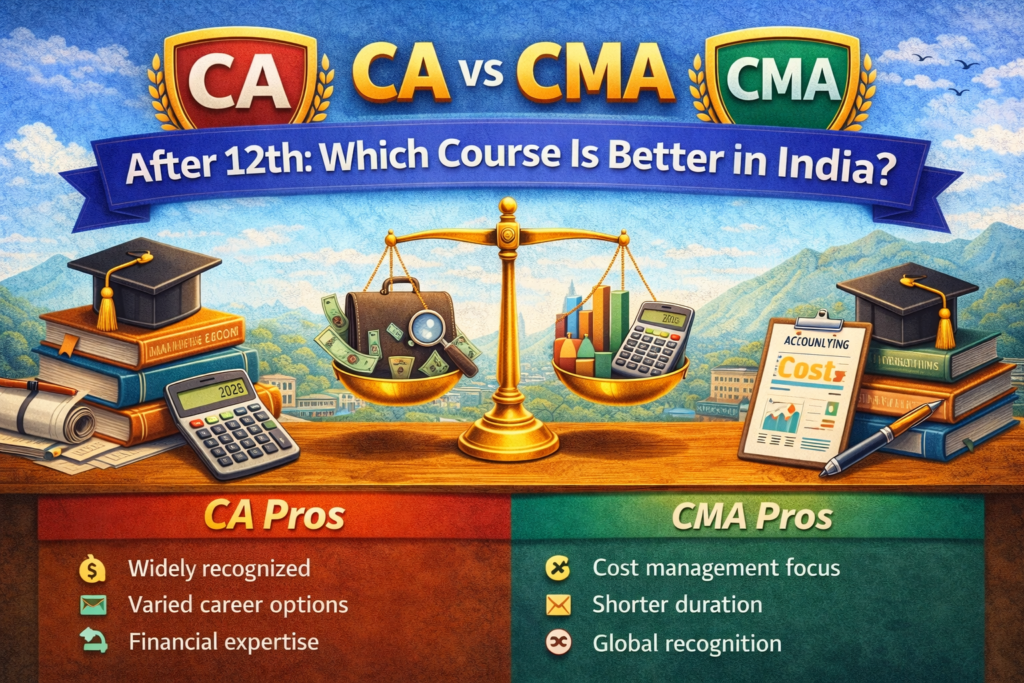
CA vs CMA After 12th: Which Course Is Better in India?
Choosing a professional career after Class 12 can feel overwhelming for commerce students. When students research CA vs CMA after 12th, they are usually trying to understand which qualification offers better career opportunities, salary potential, and long-term stability in the finance industry.
Both Chartered Accountancy (CA) and Cost and Management Accountancy (CMA) are prestigious professional courses in India. However, they lead to different career paths, require different skill sets, and offer different work environments.
This guide explains the complete comparison of CA vs CMA after 12th, including course structure, difficulty level, salary prospects, career scope, and future opportunities.
By the end of this article, you will clearly understand which course is better for your career goals.
Understanding the Difference in CA vs CMA After 12th
Before deciding between the two, students must understand that CA and CMA serve different roles in the financial ecosystem.
Chartered Accountants focus mainly on financial compliance, taxation, auditing, and regulatory reporting. Their job is to ensure businesses follow financial laws and maintain transparency.
Cost and Management Accountants focus on internal business strategy, cost management, and financial decision-making. Their role is to improve business efficiency and profitability.
In simple terms:
- CA ensures financial accuracy and legal compliance
- CMA helps businesses optimize financial performance
Both professions are highly respected but require different career interests.
Why Students Compare CA vs CMA After 12th
When students search CA vs CMA after 12th, they are usually facing several concerns.
Many students want to know:
- Which course is easier to complete?
- Which course has better salary prospects?
- Which profession has higher respect in society?
- Which option offers faster career growth?
Parents also influence this decision. In many households, CA is still seen as the “gold standard” commerce qualification.
However, the growing corporate sector in India has increased demand for CMA professionals who specialize in financial strategy and cost management.
Understanding these differences helps students make a more informed career decision.
CA Course Structure After 12th
The Chartered Accountancy course is conducted by the Institute of Chartered Accountants of India (ICAI).
CA Levels
- CA Foundation
- CA Intermediate
- Articleship Training (2 years)
- CA Final
Average Course Duration
The CA course generally takes 4.5 to 5 years to complete.
However, some students take longer due to exam attempts.
Key Subjects in CA
The CA curriculum focuses heavily on accounting, auditing, and taxation.
Important subjects include:
- Financial Reporting
- Direct Tax
- GST and Indirect Tax
- Corporate Law
- Auditing and Ethics
- Strategic Financial Management
These subjects prepare students for roles in financial compliance and corporate governance.
CMA Course Structure After 12th in the CA vs CMA Comparison
The Cost and Management Accountancy course is conducted by the Institute of Cost Accountants of India (ICMAI).
CMA Levels
- CMA Foundation
- CMA Intermediate
- Practical Training (15 months)
- CMA Final
Average Course Duration
The CMA course typically takes 3 to 4 years to complete.
Key Subjects in CMA
The CMA syllabus focuses more on management accounting and financial strategy.
Important subjects include:
- Cost Accounting
- Strategic Cost Management
- Corporate Financial Reporting
- Performance Management
- Financial Planning and Analysis
- Risk Management
These subjects prepare students to work in corporate finance roles and strategic business positions.
CA vs CMA After 12th: Key Differences
1. Difficulty Level in CA vs CMA After 12th
The CA course is widely known for its very low pass percentages and high difficulty level.
Some CA Final exam sessions have pass rates below 15% for both groups combined.
CMA exams are still challenging but usually have slightly higher pass percentages, making the completion path somewhat more predictable.
Students who prefer high academic challenge and prestige often choose CA, while those seeking balanced difficulty and corporate roles may prefer CMA.
2. Training Experience
A major difference in the CA vs CMA after 12th comparison is the practical training requirement.
CA Articleship
CA students must complete two years of articleship training under a practicing CA firm.
Typical experiences include:
- Working on audits
- Filing tax returns
- Assisting with financial compliance
Stipends during articleship are usually between ₹3,000 and ₹15,000 per month depending on the firm and city.
CMA Practical Training
CMA students complete 15 months of practical training, often within corporate finance departments.
Typical roles include:
- Cost analyst
- Financial analyst
- Management trainee
Stipends during CMA training are often ₹10,000 to ₹25,000 per month.
This often provides better exposure to corporate business operations.
Salary Comparison in CA vs CMA After 12th
Salary depends on factors such as:
- skills
- exam attempts
- company reputation
- industry sector
Average Starting Salary
| Qualification | Average Starting Salary |
|---|---|
| CA | ₹6L – ₹12L per year |
| CMA | ₹4L – ₹9L per year |
High Salary Potential
Rank-holder Chartered Accountants can receive ₹20L+ packages from large consulting firms.
Experienced CMAs working in corporate leadership roles can earn ₹15L–₹20L+ packages within several years.
Many multinational companies value analytical finance skills, meaning salary differences often narrow as professionals gain experience.
Career Opportunities in CA vs CMA After 12th
Both professions offer strong career opportunities in India.
CA Career Paths
Chartered Accountants commonly work as:
- Statutory auditors
- Tax consultants
- Forensic accountants
- Financial controllers
- Compliance advisors
They often work in:
- Big 4 accounting firms
- consulting firms
- corporate finance departments
- independent audit practice
CMA Career Paths
Cost and Management Accountants commonly work as:
- Cost analysts
- Financial planning analysts
- Corporate finance managers
- Business strategy advisors
- Budget analysts
They are highly valued in sectors such as:
- manufacturing
- infrastructure
- logistics
- FMCG companies
- multinational corporations
Future Career Scope in CA vs CMA After 12th
The finance profession is evolving rapidly due to automation, artificial intelligence, and data analytics.
Routine accounting tasks are increasingly automated.
However, professionals who can interpret financial data and guide strategic decisions are becoming more valuable.
Future Roles for CAs
Chartered Accountants are moving toward roles such as:
- forensic auditing
- international taxation
- regulatory advisory
- sustainability reporting
Future Roles for CMAs
CMAs are increasingly involved in:
- financial planning and analysis (FP&A)
- cost optimization strategies
- business intelligence
- strategic finance leadership
Both careers remain highly relevant in the modern economy.
CA vs CMA After 12th: Which Course Should You Choose?
The right choice depends on your career interests and strengths.
Choose CA if you want to:
- specialize in auditing and taxation
- build an independent professional practice
- work in financial compliance roles
- pursue high-prestige professional recognition
Choose CMA if you want to:
- work in corporate finance
- focus on business strategy
- analyze company performance
- influence financial decision-making inside organizations
Understanding your long-term goals is essential when deciding CA vs CMA after 12th.
Why the Right Guidance Matters
Professional courses like CA and CMA require consistent preparation, conceptual clarity, and strategic study planning.
Many capable students struggle simply because they lack:
- proper mentorship
- structured preparation
- exam-focused practice
Guidance plays a crucial role in improving success rates in professional commerce education.
Why Concept Classes of Commerce (C3) Stands Out
At Concept Classes of Commerce (C3), we focus on building strong conceptual understanding rather than rote learning.
Our programs help students prepare for professional commerce careers with structured guidance and mentor support.
Key strengths include:
- 20+ years of teaching experience
- CMA-qualified faculty
- structured test series
- bilingual teaching approach
- personalized mentoring support
Our goal is to help students build confidence and clarity before entering professional courses like CA and CMA.
Frequently Asked Questions
Is CA better than CMA after 12th?
CA is better for students interested in auditing, taxation, and independent practice, while CMA is ideal for corporate finance and business strategy roles.
Which course is more difficult?
CA is generally considered more difficult due to lower pass percentages and rigorous exam evaluation.
Can CMA earn as much as CA?
Yes. Experienced CMAs in corporate leadership roles can earn salaries comparable to CAs, especially in manufacturing and multinational companies.
Can students pursue both CA and CMA?
Yes, some students attempt both courses simultaneously, but it requires strong time management and disciplined preparation.
Which course has better job security?
Both CA and CMA offer strong job security because finance professionals are essential in every industry.